

Few people might choose to become a bus driver after working an office job. But for Tonya, a Minneapolis mom of three, switching careers to drive buses was a welcome change when her position at a bank ended.
“It got me out from being in front of a computer all day,” she said. “A lot of the other drivers seem to want to, as they refer to it, ‘get out of the seat.’ But it was part of my goal to get away from the corporate side. I’m just trying to get into the seat!”
Tonya has relied in part on unemployment insurance (UI) at times during her career to cover costs during brief employment gaps. She applied for UI again to help support her family during a 10-week period between her most recent jobs last summer.

Nationally, the share of unemployed people receiving unemployment insurance was 28 percent in 2025. But there are notable differences between states in this recipiency rate, varying from 52 percent in Minnesota to eight percent in Florida.
Millions of US workers use UI in this way as a temporary financial bridge, typically after being laid off or seeing a job contract come to an end. UI benefits can help workers transition in their careers and more quickly re-enter the workforce.
“It depends on the individual, but unemployment insurance can be very helpful if it aligns properly with your situation,” said Tonya.
Yet many workers who lose their jobs don’t receive UI, according to recent Federal Reserve community development research. Each state has its own program rules, so UI recipiency rates—the share of unemployed people receiving UI benefits—vary widely across the country. Fed researchers showed that this variation has increased in recent years, with a national average UI recipiency rate of just 28 percent in 2025.
“Low- and moderate-income workers being able to access UI matters a lot for their financial security and labor market outcomes. What we think gets less attention than it could are all the factors that play into whether a given worker can even access the program.”
Ryan Nunn, f. Federal Reserve Bank of Minneapolis
“Low- and moderate-income workers being able to access UI matters a lot for their financial security and labor market outcomes,” said Ryan Nunn, former assistant vice president in Community Development and Engagement at the Minneapolis Fed. “Economists have studied UI quite a bit. But what we think gets less attention than it could are all the factors that play into whether a given worker can even access the program.”
Why aren’t more unemployed people applying for or receiving UI? To explore this question, Fed community development staff reviewed existing research, analyzed UI data, and spoke with people who’ve considered and applied for UI benefits.
Their work highlights the range of workers like Tonya in different states who could be accessing UI during employment gaps. It also lends greater understanding to how well those benefits align with workers’ needs—and why some unemployed people aren’t receiving benefits at all.
Variations across states in rates of unemployed workers receiving benefits
Each state takes its own approach to UI duration, eligibility, and provision. Individuals can receive UI benefits for a maximum of 26 weeks at a time in most states and as few as 12 weeks in others.
UI benefits amount to just a portion of an individual’s recent average weekly earnings, a percentage called the replacement rate. Nationally, people who qualify receive about 40 percent of their average weekly earnings in UI benefits. This replacement rate varies from roughly 30 to 55 percent by state, according to US Department of Labor (DOL) data.
Unemployed Workers Receiving UI (Recipiency Rate) by State, 2025
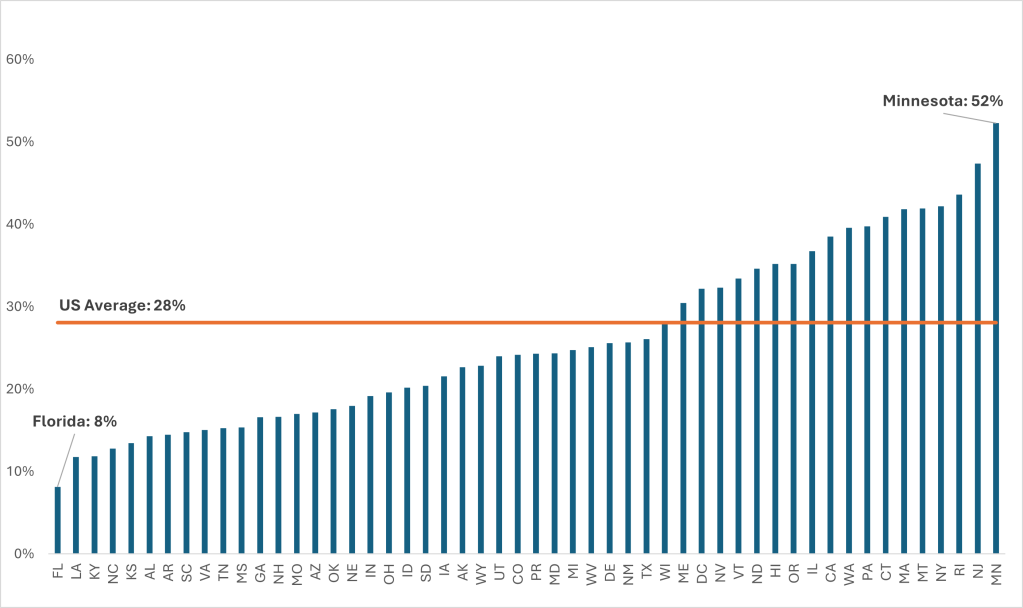
Source: US Department of Labor.
There are also notable differences between states in the share of unemployed workers receiving UI, known as the recipiency rate. DOL data show that state recipiency rates varied in 2025 from 52 percent in Minnesota to eight percent in Florida. Fed researchers observed that overall recipiency rates have largely decreased over time since 1999, and eligibility rates have declined since 2007 as well.
Understanding why some unemployed people don’t receive UI
Better understanding why UI recipiency rates are low overall and vary so much across states required the Minneapolis Fed community development team to dig deeper.
“What we’ve learned is that there are a number of observable factors that matter but not enough to fully account for the variation across states or the decline over time,” said Nunn.
For example, Nunn and Minneapolis Fed associate data scientist Juliet Cramer found that unemployment continuing beyond the 26-week limit of most states’ UI benefit duration has grown since 2000. During the same time frame, several states reduced the maximum number of weeks an individual can receive UI benefits below 26 weeks.
Both factors play into the falling UI eligibility rate in recent years. People who remain unemployed beyond their state’s UI benefit time limit are no longer eligible to apply for or receive benefits.
The role of administrative burdens and constraints
In another UI exploration, researchers looked into administrative burdens, or aspects of different states’ UI processes that may frustrate or deter applicants. Application processes and eligibility requirements in each state can be hard to navigate without help.
“We made phone calls to the different states to see how long it took to reach a human,” said Ayushi Narayan, an economist in Community Development and Engagement at the Minneapolis Fed. “We manually went to each website to see if there were restricted hours. We wanted to know what type of assistance you would have to complete the application correctly if you get stuck.”

Unemployment insurance application processes and eligibility requirements can be hard to navigate without help. In calls to 26 states, Fed researchers found that it took more than 30 minutes to reach a human or that a human respondent wasn’t available at all.
They discovered that while you can apply for UI benefits by phone in some states, in others you have to apply online or in person. Some states’ applications aren’t available on mobile browsers, which can make it harder for people in rural places or areas with less broadband access to apply.
The study also showed that 20 states offer their UI application only in English. In calls to 26 states, researchers found that it took more than 30 minutes to reach a human or that a human respondent wasn’t available at all.
Talking with program administrators, Narayan learned that evolving UI programs can be costly and difficult. “It’s an old program,” she said. “A lot of states are doing their best, but there can be limits on how much money or time they have to make changes.”
UI access and receipt barriers for certain unemployed groups
“We do know there are some groups who are less likely to apply for or receive UI,” said Narayan. “Some of that is due to how the program is designed.”
For example, a parent or caregiver might not be considered available to work—a UI eligibility requirement—if they can’t quickly accept a new job because they don’t have access to child care aligned with their work hours.
Some people also find that their recent work experience doesn’t qualify under UI rules.
Minimum work history and earnings requirements can exclude certain lower-income and nontraditional workers from UI. Independent contractors and gig workers generally don’t qualify either.
“Seeing an important part of our community and workforce not being acknowledged in the data, it was clear that we needed to talk to people to really understand what was happening there. I felt like the Fed had a unique role in exploring that further.”
Mary Hogan, Federal Reserve Bank of Minneapolis
A desire to better understand these workers’ UI experiences sparked much of the Minneapolis Fed team’s broader UI research in 2025, according to Narayan and Nunn. Their community development colleagues—special projects lead Mary Hogan and former research assistant Amalea Jubara—proposed holding focus group conversations with one group of workers impacted by many of these barriers: lower-income women.
Learning from those with lived experience
“For me, the main motivation was seeing this important part of our community and workforce not being acknowledged in the data,” said Hogan. “It was clear that we needed to talk to people to really understand what was happening there. I felt like the Fed had a unique role in exploring that further.”
Hogan and Jubara worked with Minneapolis community organizations to arrange focus groups with 20 lower-income women who had been unemployed at some point between 2019 and 2024.
Uncertainty was the major theme of the conversations, Hogan and Jubara said. Participants shared that they felt eligibility rules were hard to find and understand. Some thought they earned too much in their previous jobs to qualify, while others assumed they hadn’t earned enough. They expressed concerns about how applying for UI could expose them to risk or impact other benefits their families relied on.

In focus groups, lower-income workers shared that they felt UI eligibility rules were hard to find and understand. Some thought they earned too much in their previous jobs to qualify, while others assumed they hadn’t earned enough. They expressed concerns about how applying for UI could expose them to risk or impact other benefits their families relied on.
“The website has these general eligibility requirements, but a person needs to apply for UI to have the state agency look at their case to see if they’re eligible,” said Hogan. “They wondered, if they applied, would it end up harming them more than helping them?”
Some participants said it wasn’t clear how benefits were calculated and whether it would be worth the trouble.
“A lot of low-income workers don’t even have time for it,” said Jubara. “They’re caretaking and balancing family and immediate needs, often without the cushion to absorb uncertainty.”
“People are weighing the trade-off between time spent navigating an uncertain process and time spent seeking work. If they’re not sure they’ll qualify or the benefit will meet their needs, they may decide applying for unemployment insurance isn’t worth their time.”
Amalea Jubara, Federal Reserve Bank of Minneapolis
“People are weighing the trade-off between time spent navigating an uncertain process and time spent seeking work,” she added. “If they’re not sure they’ll qualify or the benefit will meet their needs, they may decide applying for UI isn’t worth their time.”
One worker’s mixed experience with UI benefits
Minneapolis mom and bus driver Tonya’s most recent UI experience is a prime example of this problem. On some previous occasions, she said, the UI amount she received covered many of her expenses. But when she applied for UI to cover last summer’s employment gap between jobs, her weekly UI benefit amounted to $100—much less than she expected.
“The benefit wasn’t really worth it for me,” she said. “It was nowhere near the amount I was making. I had to go super low budget to survive those months. I ended up applying for food support, which was something I did not want to do. I was really happy when my new job started.”
Tonya said she still would recommend that others who are eligible apply for UI, in part because of one UI-related support people may not know about. Dislocated worker programs, run through community-based centers, help UI recipients search for new jobs, find and cover the cost of training, and access other services during unemployment.
Tonya said she hopes she won’t ever need to use UI again. “But if I did, I would know exactly how to use it based on the experiences I’ve had over the years,” she said. “I still think it’s a great insurance program, because at the end of the day, you’re receiving something to help support your daily needs while you’re not working.”
Informing UI approaches that work for today’s labor force
There are still many factors to explore around UI access and effectiveness, Fed researchers said. They note that they aren’t recommending particular policy interventions, nor can they define what an optimum UI program might look like. But their research offers a unique lens into many of the factors impacting UI availability and how well UI is working for different unemployed groups.
“It’s a distinctive community development contribution to have the qualitative and quantitative research inform each other,” said Nunn. “We use nationally representative data samples to understand the reach of a program like UI and the effect it has on the economy and the labor market. But then there’s a real need to understand what the process of engaging with UI feels like to people who are actually receiving it.”
Hogan said she hopes the Fed’s research approach sheds light on the barriers preventing some unemployed people from receiving UI benefits.
“This program was founded in the 1930s,” she said. “Think about how much the US workforce has changed. Speaking with people who are often left out of the conversation helps us understand why some in today’s labor force may have difficulty accessing UI benefits—or decide it’s not worth doing so—during periods of unemployment.”