




Beyond healing the sick, hospitals and healthcare systems provide an outsized economic lifeline in many US regions.
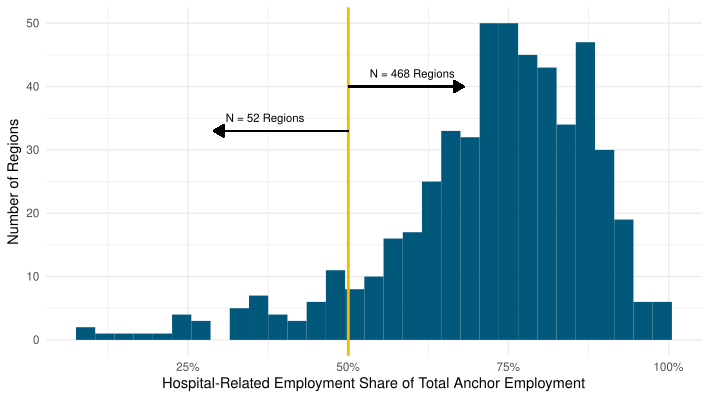
The Federal Reserve Bank of Philadelphia began quantifying hospitals’ economic contributions in 2021, when it launched its Anchor Economy Initiative, the first regional assessment of the economic impact of both hospitals and university institutions (otherwise known as “anchor institutions”). The most recent anchor economy data show hospitals supporting 13.7 million jobs nationwide. By comparison, universities support 5.8 million positions. In 90 percent of regions, hospitals represent more than 50 percent of anchor employment (Figure 1).
The national data highlight why hospitals, along with universities, are referred to as anchor institutions, serving as an economic foundation to many regions. A total of 220 regions across the country have above-average reliance on hospitals and universities for economic activity, while nationally these institutions are responsible for 9 percent of employment and 8 percent of gross domestic product.
Figure 1: Hospital-Related Employment
Despite their substantial role as employers, hospitals face significant challenges in recruiting and retaining workers, developing the future workforce, providing competitive wages, and fostering a welcoming workplace. Addressing these workforce gaps serves both patients and the communities they live in and is especially important given healthcare’s contribution as a vibrant economic anchor.
Hospitals vs. universities as anchors to a region’s economy
Hospitals and related facilities not only employ large numbers of workers, but they also generate significant indirect, secondary economic impacts. Besides direct hiring, hospitals purchase goods, such as linen and cleaning supplies, and provide services, like legal and technical services, which support additional local indirect jobs.
Additionally, hospital employees contribute to the local economy through their spending at businesses such as restaurants, entertainment venues, grocery stores, and other retail establishments. This spending supports additional local jobs and economic activity, generating what are referred to as “induced effects.” These indirect and induced employment effects from hospitals are more pronounced than those of higher education institutions. For example, hospital jobs produce another 0.78 jobs in the local economy, while higher education institutions yield an additional 0.32 positions.
Moreover, hospital employment is closely tied to population size. As population grows in a region, hospital employment also increases. By comparison, higher education employment has not been shown to rise when population increases.
Hospital care is a comprehensive service, touching residents of all ages, all year-round, where higher education serves a smaller proportion of local residents (typically those aged 18-24) and is more seasonal in nature, as fewer classes are typically offered in the summer. Healthcare’s relationship between population size and anchor employment is critical, as growing regions’ needs for more hospital training and workers simultaneously expand with population. Conversely, regions losing population spells trouble for hospitals trying to keep their doors open.
Healthcare workforce shortages
As of July 2026, hospitals directly employed 5,770,400 individuals while healthcare overall accounted for 18,518,500 workers, according to US Labor Department data. Despite these hefty numbers, workforce shortages involving physicians and allied healthcare workforce positions persist. The Health Resources and Services Administration (HRSA), a part of the US Health and Human Services Department, estimates a physician shortage of more than 96,000 practitioners in 2026. The shortfall is expected to exceed 127,000 by 2030.
The shortages appear to be even greater for allied healthcare workers and nurses. Allied healthcare workers are positions outside of nursing roles that support physicians through prevention, diagnostics, and treatment. Among registered nurses, the deficit stands at almost 264,000 in 2026, though it is projected to slightly ease to 251,000 by 2030. The licensed practical nurse deficit totals 94,000 in 2026 and is projected to exceed 148,000 by 2030.
Put another way, only 88 percent of physician demand will be met in 2030 compared with 93 percent of registered nurse demand and 80 percent of licensed practical nurse demand. Other allied health positions facing shortages include respiratory therapists, laboratory technicians, pharmacy technicians, and radiology technicians.

Why shortages are likely to grow
There is not one single reason for these shortages, but rather a series of challenges coming to a head. A central issue is demographics. Almost 40 percent of registered nurses at critical access hospitals were over age 50 in 2018. Staff aging was even greater at public clinics such as rural health centers (42 percent over age 50) and at hospital-sponsored ambulatory care (51 percent older than 50). Among licensed practical nurses, one-third were over age 55, with retirement imminent for many.
Making the shortfall more pronounced is an expected increase in the demand for healthcare as the nation’s population grows older and its younger cohorts shrink. The share of the population 65 and older by 2030 (20.6 percent) will surpass the share of those under age 18 (20.0 percent). This trend is predicted to persist and widen until the end of this century. Together, these demographic shifts imply:
- more people are aging out of the workforce,
- greater demand for healthcare with an aging population, and
- fewer people to train who can replace workers to meet the growing demand.
Keeping workers at their hospital jobs presents another set of obstacles. Having fewer workers amid increasing demand can create a stressful work environment, leading to burnout. Healthcare workers are also four times more likely to experience workplace violence than workers in any other private sector. Among registered nurses in 2025, 70 percent said they were verbally threatened, 33 percent said they were subject to physical threats, while just 15 percent reported that they had not experienced any workplace violence, according to a survey by National Nurses United, the nation’s largest union for registered nurses. Other reasons for shortages include salaries’ failing to keep pace with the cost of living, lack of professional mobility, and poor management.
The pandemic exacerbated these issues, leading healthcare workers to leave the workforce, further increasing the healthcare sector’s demand for labor.
Healthcare opportunity occupations
Not every healthcare workforce challenge can be solved at once. Because some roles, for example, will require more than a decade of training plus a residency to fill, workforce organizations are initially focusing on a subset of positions as a first step to help alleviate the shortages. “Opportunity occupations” are jobs that require less than a four-year degree and pay above the median wage. These positions provide a more direct pathway to join the workforce, and the training is more affordable. They also can serve as a gateway to employment for high school graduates and people needing to reskill. Additionally, because hospitals are present in most communities, people interested in these careers can remain local while retaining the flexibility to relocate later.
A report from the Federal Reserve Bank of St. Louis on opportunity occupations in healthcare found that the demand for these jobs has broadly increased since 2019 (Figure 2). Even among respiratory therapists, where demand declined in 2024, the proportion of hospitals with an opening in this position still exceeds pre-pandemic rates. These trends persist in both metro and nonmetro (NM) areas.
Figure 2: Hospitals with at Least One Job Opening

Workforce strategies
In addition to focusing on opportunity occupations, workforce organizations across the country are addressing regional healthcare workforce shortages through various strategies for recruitment and retention. These include:
- Creating leadership succession plans
- Creating talent development programs
- Partnering with elementary and high schools to develop interest in healthcare careers
- Partnering with community colleges and vocational training programs
- Establishing well-being programs
- Implementing workplace violence de-escalation training
- Providing employee benefits such as tuition assistance
Figure 3: 2024 Hospital Workforce Strategies
Figure 4: 2024 Hospital Workforce Strategies by Metro Proximity
Developing partnerships is a key strategy to bring more workers into hospitals. The St. Louis Fed report found that 72.1 percent of hospitals partnered with elementary and high schools to stoke interest among students in healthcare careers (Figure 3). A total of 84.5 percent partnered with universities and vocational schools to create a worker pipeline. The rate of hospitals in nonmetro (NM) counties both near and far from metro counties developing such partnerships is lower than those in metro areas (Figure 4).
Community organizations, too, are devising innovative strategies to bolster the healthcare workforce. Besides creating interest in healthcare jobs, these local solutions often provide tuition assistance, offering personal and career support while creating a pathway to employers for meeting future needs.
Upskill NWA, for example, partners with northwest Arkansas community colleges, universities, and hospitals to provide funding and supportive services such as child care for students training to become registered and licensed practical nurses as well as respiratory therapists, with the goal of creating an occupational pipeline. The Memphis Medical District created Hire Local to help design course content, so students may be trained in two years and interview for a job upon graduation. In a final example, which leverages community partnerships and aims to encourage interest in healthcare careers and build skills in the community, HealthForce Kentucky has both a training hub for healthcare simulations and two semi-trucks with built-out bays. These bays are dedicated to different professions as a mobile classroom to teach area children about career opportunities in healthcare. As worker shortages are addressed, such programs can improve access to healthcare and local economies.
Looking towards the future
While workforce organizations, hospitals, and schools seek to address workforce shortages for hospitals serving as vital economic anchors, possible new workforce challenges arise. Artificial intelligence (AI) is one of them. It can both augment clinical work (AI-assisted diagnostics) as well as support administrative work (staff scheduling). While AI may potentially alleviate staff shortages and support hospital profitability, the technology’s ultimate impact remains unclear. It is likely, however, that students and current employees may need to adopt new technologies to remain marketable.
On the individual level, economic security for employees and improved well-being for area residents are important benefits of anchor institutions, including hospitals. At the community level, a strong health care sector can contribute to a better quality of life with healthcare options that help retain and attract area residents. Finally, spending by employees and the organization can stimulate economic growth and draw new business development. Medical sector anchor institutions may best help their communities with local solutions that support their work while helping residents thrive.


Occupational Mobility Explorer
This interactive tool sheds light on career pathways in the U.S. labor market. The tool allows users to explore career paths and visualize how job skills needed for specific occupations can transfer to higher-paying occupations in the same geographical area. Users can also access resources to help them search for jobs in their region and build a skills-based resume.

