

US homeowners insurance premiums are on the rise, increasing roughly 70 percent between 2019 and 2025. The premium, which is the amount a homeowner pays to protect their property against loss or damage, is an important cost consideration when it comes to overall housing affordability. Last year, the premium represented 14 percent of an average homeowner’s monthly housing costs, up from 10 percent in 2013.
Federal Reserve research suggests that recent insurance premium increases are contributing to growing housing-cost strain, especially for lower- and middle-income homeowners. Here are some key research takeaways about how premium increases are affecting housing affordability and stability.
Rising insurance costs impact homeowners differently
A range of factors affect a homeowner’s insurance premium pricing, including the age and construction of a home and likelihood of a natural disaster in the area. The cost and availability of materials needed to repair or rebuild a home influence pricing. Insurers also take into account the homeowner’s credit score and any previous claims on insurance for home loss or damage. As a result, premium pricing varies over time, geography, and homeowner characteristics.
For example, Dallas Fed researchers found that some states saw more pronounced premium increases, including Utah, Idaho, Florida, and Texas, between 2019 and 2024. In Minnesota and North Carolina, premium prices grew five times faster than incomes.
On average, the lowest-income homeowners spend the largest share of their income on homeowners insurance, according to a Chicago Fed analysis. Rates of nonpayment-related insurance cancellations were also highest in zip codes with the lowest median incomes.
Lower-income homeowners have been disproportionately affected by increasing insurance premium prices. For instance, Philadelphia Fed research showed that premium rates for properties in lower-income neighborhoods were higher and increased more substantially than those in middle- and higher-income neighborhoods in Delaware, New Jersey, and Pennsylvania between 2021 and 2025.
On average, the lowest-income homeowners spend the largest share of their income on homeowners insurance, according to a recent Chicago Fed analysis. Rates of nonpayment-related insurance cancellations were also highest in zip codes with the lowest median incomes. Researchers found that disparities in cancellation rates between the lowest- and highest-income zip codes were more significant in certain states—including Michigan, Indiana, and Illinois—than in the US overall.
Household responses to premium increases also varies across income levels
Recent research also reveals that homeowners with lower incomes, lower credit scores, or both can face starker choices when homeowners insurance premiums rise. For example, one study found that lower-income homeowners scale back their coverage as premium costs rise. The coverage gap can leave them underinsured and vulnerable to more significant equity losses if their homes are damaged or destroyed.
In regions with sharper increases, higher-income households were more likely to have sufficient resources to move to areas with lower premiums, according to Dallas Fed research that examined data from 2015 to 2023. Meanwhile, financially constrained households in these areas largely did not move. Under the strain of increasing housing costs, these households also relied more heavily on credit cards to manage expenses and were more likely to become delinquent on their mortgage payments.
“Increasing homeowners insurance premiums are making homeownership less affordable and less stable,” said Sisi Zhang, senior community development economic advisor at the Philadelphia Fed. “If people are not able to pay their insurance premiums on time, some of them will be forced into lender-placed policies, which often have higher premiums than consumers can find shopping around themselves on the market.”
Mortgage lenders may impose a lender-placed policy (also known as a force-placed policy) on a homeowner who hasn’t purchased adequate insurance or kept up with payments on a policy she chooses for herself. While lender-placed policies protect the lender against losses, they provide less coverage at greater expense to the homeowner.

“Increasing homeowners insurance premiums are making homeownership less affordable and less stable.”
– Sisi Zhang, senior community development economic advisor, Philadelphia Fed
Impact of increase not fully reflected in inflation measures

“If we’re just looking at inflation measures, that’s not going to fully capture this large shift in affordability that homeowners are feeling in their pockets.”
– Reid Taylor, research economist, Dallas Fed

Despite evidence from homeowners insurance data and personal experiences, the consumer price index (CPI) and personal consumption expenditures (PCE) index—two key inflation measures—haven’t fully reflected the significant increases in premiums. With a narrower measure of what consumers pay for shelter, the indicators may understate the real effect of higher premiums on housing affordability.
Researchers often use mortgage performance data such as McDash to track insurance premium increases. Dallas Fed researchers found these figures to be twice as high in McDash data as they appear in PCE data, and more than 12 times higher than in CPI data.
Tracking the true impact of homeowners insurance premium increases on housing costs and affordability helps the Fed monitor price stability, a main pillar of its dual mandate.
Dallas Fed Research Economist Reid Taylor said homeowners insurance premiums now are growing at a slower rate than in recent years. But premiums are still increasing at a rate of five to seven percent—higher than the Fed’s annual inflation target of two percent.
“We hear from homeowners in our communities that their prices are getting more unaffordable, but that wasn’t actually being shown in the underlying inflation measures we saw,” said Taylor. “If we’re just looking at inflation measures, that’s not going to fully capture this large shift in affordability that homeowners are feeling in their pockets.”
The economic ripple effects of rising homeowners insurance costs
Fed researchers also pay attention to household-level financial strains in part to understand how the issues affecting individual families today might impact the broader economy in the future.
“The mortgage market is the largest debt market,” said Andy Polacek, policy advisor and head of the Chicago Fed Insurance Research Center. “When households face stress and insurance costs create pressure on that market, it can potentially have some knock-on effects, such as increased mortgage defaults or consumer loan delinquencies. It’s important for the Fed to understand those dynamics.”
Dallas Fed Senior Research Economist Nitzan Tzur-Ilan said that some homeowners reported defaulting on their mortgages mainly because of insurance increases. She investigated available data to see whether continued insurance premium increases could impact the stability of the broader mortgage market over time.
“We found some results that are in line with that assumption,” said Tzur-Ilan. “Currently, the number of affected homeowners is not too high. But if you take into account growing disaster risk and related insurance costs, the numbers could get much higher, and that could have an effect on the financial system.”
Helping homeowners understand how to keep insurance costs more affordable
Sudden homeowners insurance premium increases can come as a financial shock, especially to people living in areas with relatively low disaster risk. Homeowners should be aware that increases affect consumers across the country, researchers said.

“Education could help people be more aware that they do have the option to say, ‘Let me look into a different provider or see what other coverage is available to me.’ That may be helpful for those who already own a home and are not able to just pick up and move somewhere else.”
– Rachel A. Jones, research analyst, Dallas Fed
“We saw that increases in your premium might not even be due to disaster risk in your locality or state, but may be because insurance companies operating across multiple states are increasing rates in your state to compensate for other areas,” said Rachel A. Jones, research analyst at the Dallas Fed.
She noted that improved understanding around insurance premium dynamics might help homeowners reduce their costs.
“Education could help people be more aware that they do have the option to say, ‘Let me look into a different provider or see what other coverage is available to me,’” said Jones. “That may be helpful for those who already own a home and are not able to just pick up and move somewhere else.”
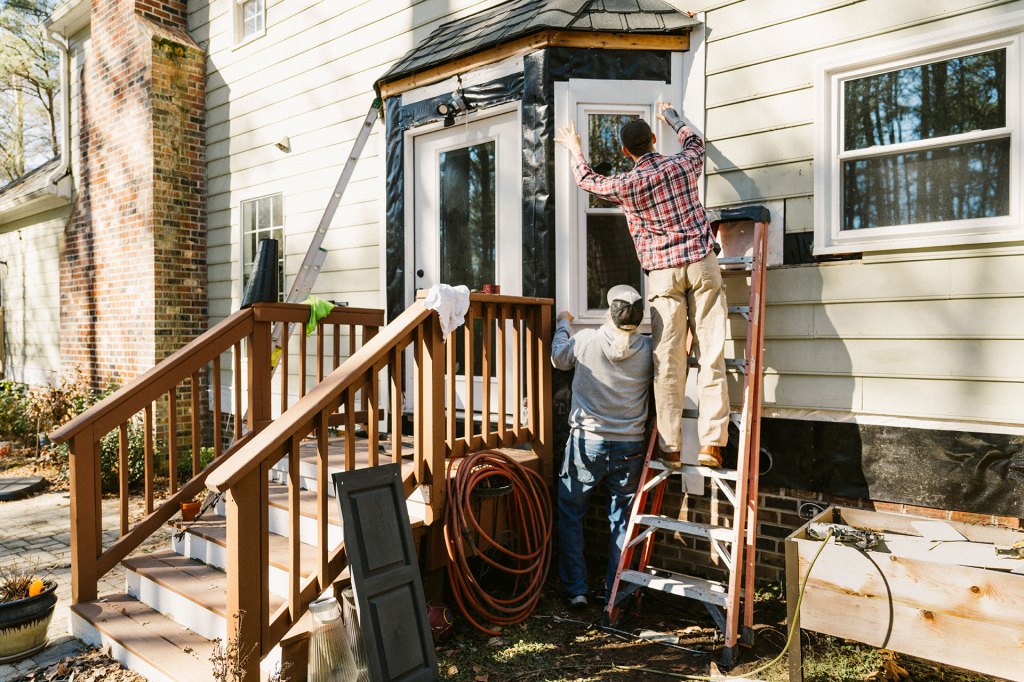
Where accessible, home-repair programs and funding assistance for upgrades could help lower-income homeowners reduce their insurance costs. Replacing a roof, installing hurricane-grade windows, or elevating a home in a high-water area require upfront expense, but may reduce insurance premiums over the long term. State and local initiatives, such as weatherization incentives and homeowner education efforts, may also help mitigate individuals’ insurance cost.
“I think there’s a conversation to be had with communities to talk about and lift up how they are responding to what their neighborhoods are facing,” said Chicago Fed Community Development Policy Advisor Robin Newberger. “It’s a good, broader conversation for us to have in community development. My hope is that organizations will see this research and use it as part of the work they’re already doing around insurance education.”