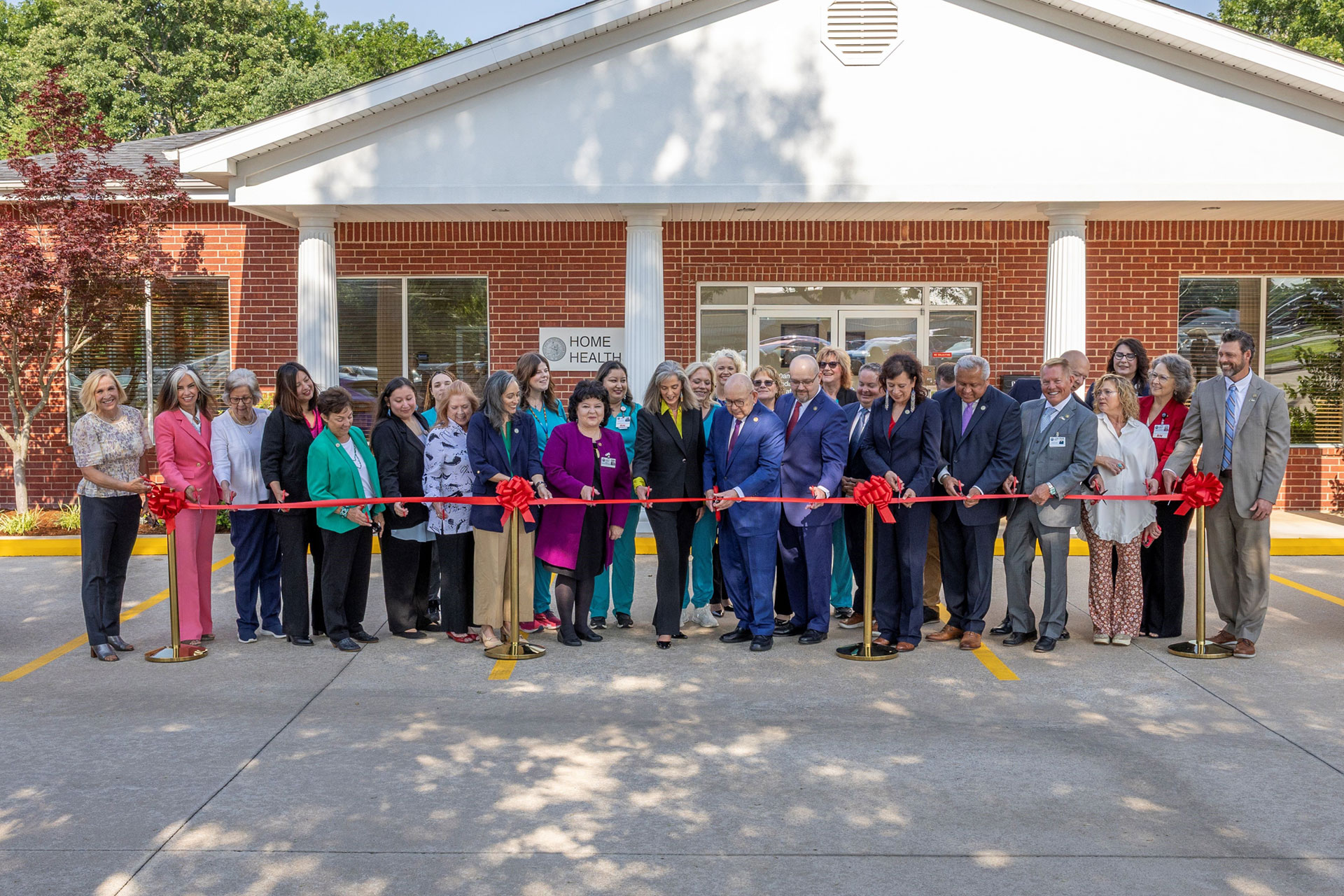
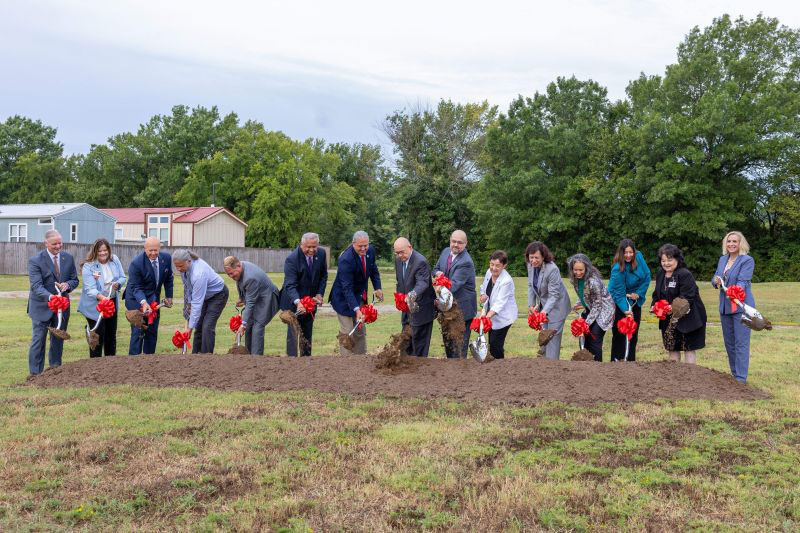
Chickasaw Nation leadership and elected officials gather for a ribbon cutting and dedication of the Chickasaw Nation’s Minticha Apila Home Health program in Ada, Oklahoma in June 2025. Photo courtesy of the Chickasaw Nation.
Investing in health, tribal nations reap more than economic benefits
By Gabriella Chiarenza, Fed Communities
Recently, a Chickasaw elder called Rear Admiral Kevin Meeks to tell him he was in the emergency room.
“I went down there to check on him,” he said. “Those nurses were just hovering over that patient because those are treasures for us. Those are our people.”
RADM Meeks, a citizen of Chickasaw Nation who serves as the tribe’s deputy secretary of health, was visiting a fellow citizen in a hospital operated by the Chickasaw Nation in Oklahoma. Serving their community is the hospital’s top priority, he explained.
“Everybody is working to enhance the overall quality of life of the Chickasaw people,” said RADM Meeks, who previously served for 32 years as a commissioned officer with the federal Indian Health Service (IHS). “The majority of our patients are our family, our relatives, and our friends. We have a built-in incentive to provide the highest quality of care in the most compassionate manner we can.”
In recent decades, a growing number of tribal governments have launched and expanded their own health care enterprises, each focused on their respective communities’ needs.

“Tribal governments run their enterprises pursuant to a core philosophy of assisting communities rather than profitmaking.”
– Andrew Huff, Senior Policy and Legal Advisor, Center for Indian Country Development
“Tribal governments run their enterprises pursuant to a core philosophy of assisting communities rather than profitmaking,” said Andrew Huff, enrolled member of the Chippewa Cree Tribe and senior policy and legal advisor at the Center for Indian Country Development (CICD), a research and policy institute headquartered at the Minneapolis Fed.
Tribes are showing that centering community also makes good economic sense. Researchers have found tribal health care enterprises in Oklahoma supported over 9,300 jobs and $762 million in wages in 2023.
“Go to other states and ask them how their rural communities are doing and they’ll tell you: not very well,” said Kyle Dean, former director of the Center for Native American & Urban Studies at Oklahoma City University. “They’re losing population. They’re having hospitals shut down. Oklahoma has new hospitals being built. That happens because the tribes are here.”
The Chickasaw Nation, the Choctaw Nation, and the Pawnee Nation are three tribal nations in Oklahoma exercising their inherent sovereign rights to design and provide the health care their communities want and need. A look at how these three nations approached that work sheds light on tribal health care enterprises’ benefits for Native people and larger regional economies.

Self-governance powers three tribal nations’ health care facilities expansion
The Chickasaw Nation and the Choctaw Nation, for example, are two of the largest tribes in the United States that have greatly diversified their business ventures. Both opted for self-governance compacts with IHS beginning in the 1990s. Since then, each nation developed and funded dozens of health care facilities throughout their reservations.
In 1994, the Chickasaw Nation was the first tribe to enter into a compact with IHS to assume operation and administration of their health care system.
“The freedom that tribes get assuming operation of their health care program should not be underestimated,” said RADM Meeks. “You can provide more direct, local, specific health care for your people, instead of relying on federal laws, policies, and programs to do that.”
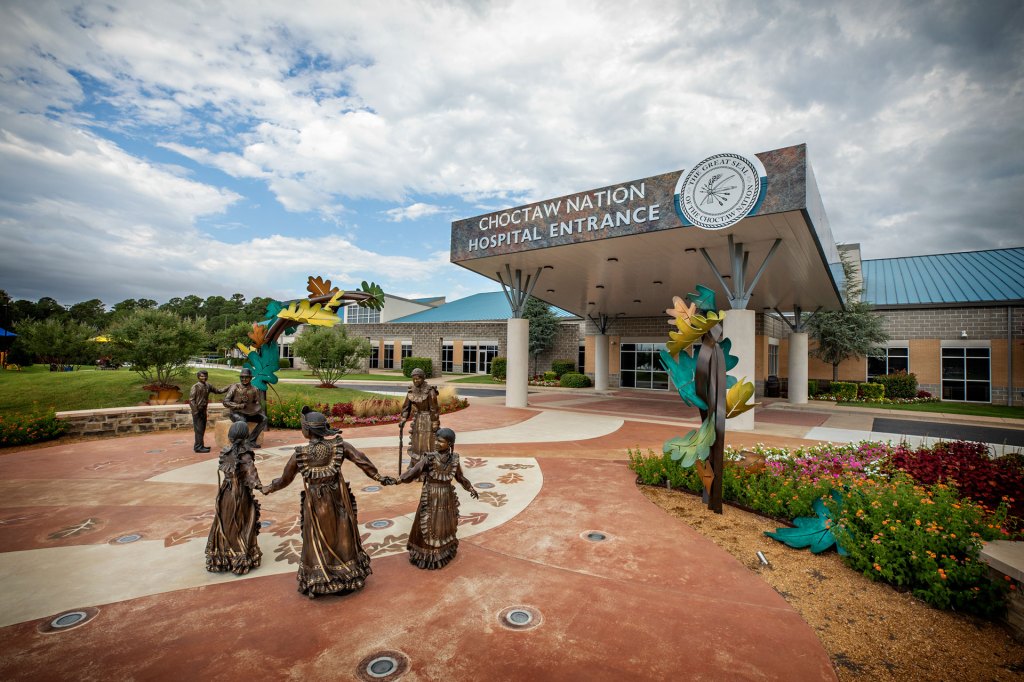
In 1999, the Choctaw Nation was the first tribe to develop and fund their own hospital: the Choctaw Nation Health Care Center in Talihina, Oklahoma.
“Without compacting and utilizing our sovereignty, we would not be where we are today,” said Gary Batton, chief of the Choctaw Nation for 11 years and executive director of health from 1997 until 2007. “It used to be that a prescribed amount was going to dental or behavioral health. Now we had the opportunity, responsibility, and accountability to listen to our tribal members, determine what their needs were, and build a system that met their needs.”
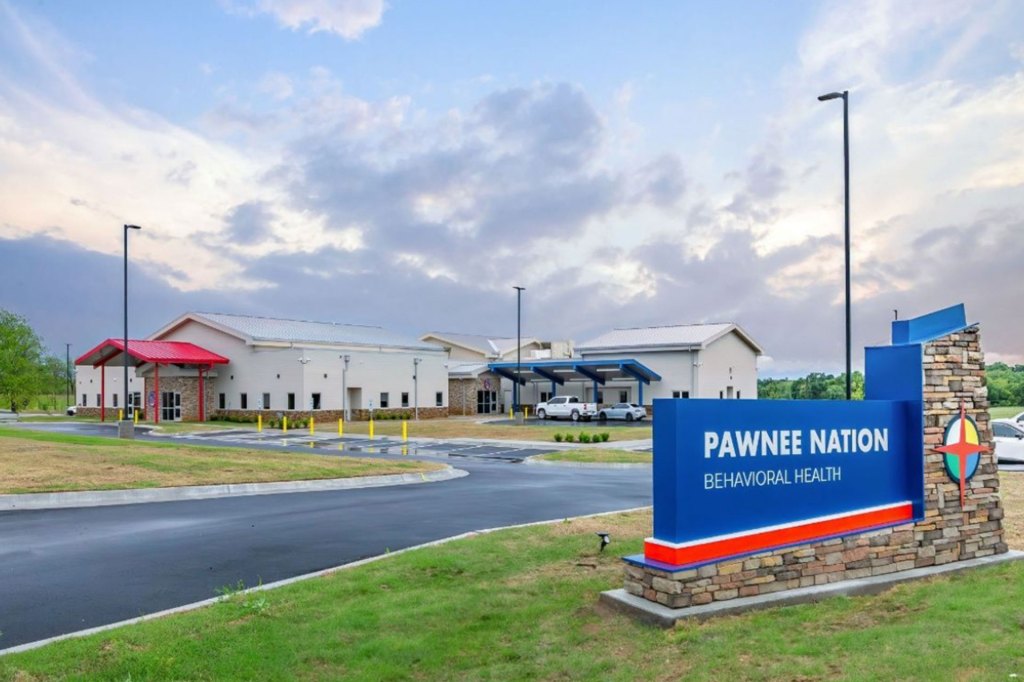
As a smaller tribe, the Pawnee Nation largely opted to continue having IHS provide direct services to the community. Recently, though, the tribe compacted with IHS to develop a new behavioral health center.
Entering into a self-governance compact for this facility enabled the Pawnee Nation to design services informed by cultural traditions specific to their nation and other tribal nations in eastern Oklahoma. Cultural competency is particularly important to the success of substance abuse and behavioral health treatment and prevention programs, said Tiffany Frietze-Nichols, citizen of Pawnee Nation and division director for Pawnee Nation Health and Community Services.
Representatives of all three tribal nations said that continuous community input regularly informs their efforts to improve and enhance their facilities and services.
“We heard the community tell us that this was an issue,” said Frietze-Nichols of the community push for a specially tailored behavioral health facility. “It was really empowering for our tribe to go to self-governance, to be able to do what we wanted to do with our funding and help out exactly how we wanted to, incorporating our cultural traditions.”
“Sovereignty gave us that ability to invest in our people,” added Brian Kirk, an enrolled member of the Citizen Potawatomi Nation who serves as the program manager at Pawnee Nation Behavioral Health.

“Without compacting and utilizing our sovereignty, we would not be where we are today. It used to be that a prescribed amount was going to dental or behavioral health. Now we had the opportunity, responsibility, and accountability to listen to our tribal members, determine what their needs were, and build a system that met their needs.”
– Chief Gary Batton of the Choctaw Nation of Oklahoma
“It was really empowering for our tribe to go to self-governance, to be able to do what we wanted to do with our funding and help out exactly how we wanted to, incorporating our cultural traditions.”
– Tiffany Frietze-Nichols, Division Director, Pawnee Nation Health and Community Services

“Sovereignty gave us that ability to invest in our people.”
– Brian Kirk, Program Manager, Pawnee Nation Behavioral Health
A range of funding sources to raise up healthcare infrastructure
Unlike state and local governments, tribal governments largely cannot or do not levy taxes. CICD’s analysis of recent Survey of Native Nations data showed that for tribal governments participating in the study, tax revenue made up an average of just 1.7 percent of total revenue, compared with 44.8 percent for local governments and 42.2 percent for state governments across the country.
Longstanding challenges around access to credit also have limited resources available to tribal governments for economic development.
“Research has found that tribes experienced their own version of redlining where banks weren’t making themselves very available in Indian Country, so some tribes reportedly haven’t had the same access to bank loans,” said CICD’s Huff.
Without tax revenue and full access to traditional bank lending, tribal nations must look elsewhere to fund community facilities and services. A key funding source opened up with the passage of the Indian Gaming Regulatory Act (IGRA) in 1988. IGRA stipulated that tribal nations could run gaming enterprises on tribal trust land provided that any gaming revenue be used to support their communities.
In addition to drawing on gaming and other enterprise revenues, tribal nations have used different approaches to fund construction and operation of their health care enterprise buildings.
The Chickasaw Nation and the Choctaw Nation won Joint Venture Construction Program awards to help cover staffing and operations costs for new health care facilities. Under this IHS program, tribes develop or renovate a health care facility using non-IHS funding sources and then enter into a no-cost lease with IHS for a period of 20 years. In exchange, IHS makes requests to Congress to support staff, operations, and maintenance costs for the facility.
Tribes also work with Native community development financial institutions (Native CDFIs) and other CDFIs to source facility development capital.
With more limited financial resources on hand, the Pawnee Nation got creative building out a capital stack to fund development of their behavioral health center. The tribe contributed $1 million to the project, then put together over $20 million in additional funding from sources including USDA Rural Development, New Markets Tax Credits via Clearinghouse CDFI, and a guaranteed loan from another CDFI, Native American Bank.
The Survey of Native Nations is a collaboration between CICD and tribal governments to improve the public finance data available to Indian Country. Participating tribes receive a confidential report showing their revenue and expenditure data in comparison to aggregate, anonymized data for all participating tribes across the country as well as benchmark data for selected local and state governments in their region. The Survey of Native Nations is open to all tribes across the country.
Economic and community impacts of tribal health care enterprises
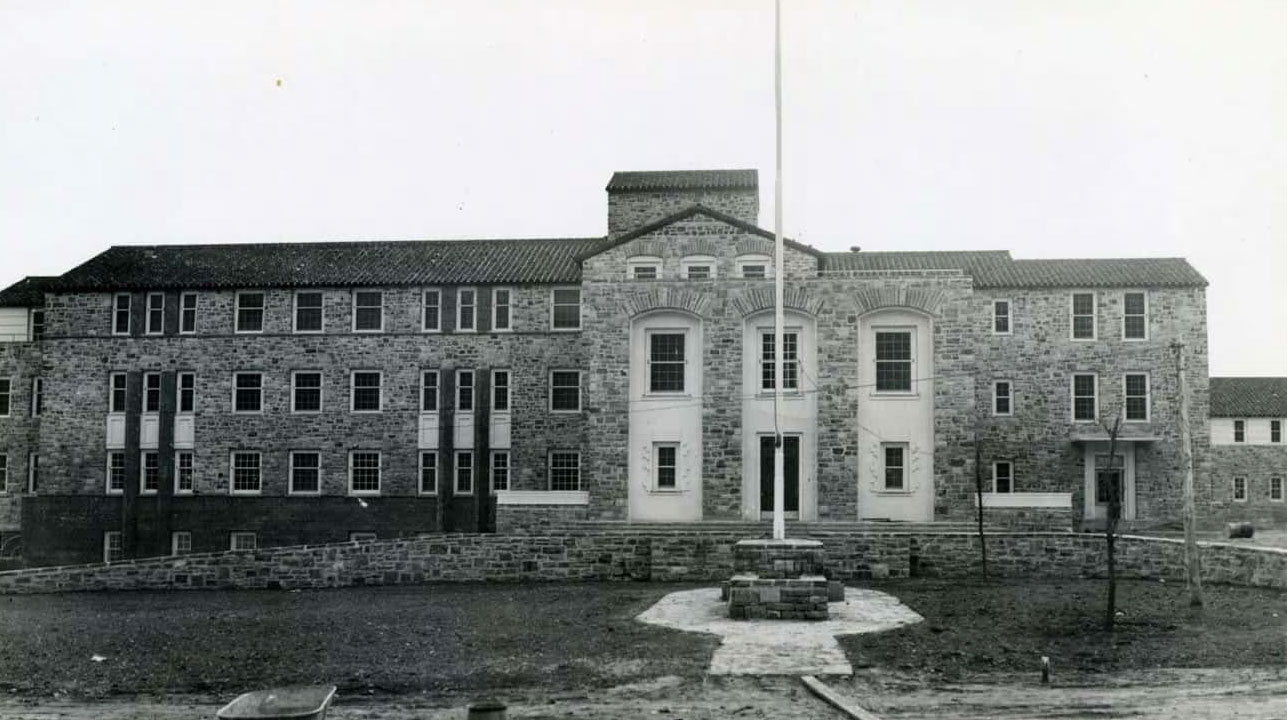
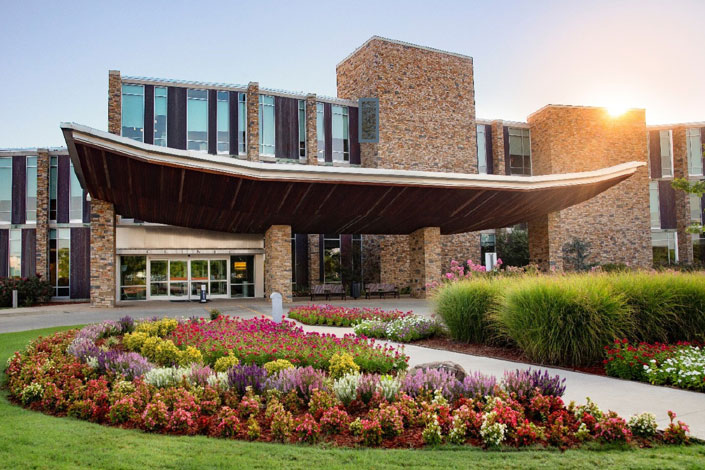
Regardless of how they choose to fund and deliver health care in their communities, tribal nations are making vital contributions to the overall health care landscape in rural places like Oklahoma. Many areas where tribal nations are developing new facilities were health care deserts. RADM Meeks noted that in the past, people in far-flung parts of the Chickasaw Nation had to drive over 150 miles to access care.
Governor Bill Anoatubby of the Chickasaw Nation and Chief Batton of the Choctaw Nation viewed these access gaps as unacceptable. Both established a goal early in their leadership that all of their nations’ citizens should be within a 30-mile drive of a high-quality health care facility. Strategic placement of facilities throughout both nations’ geography is helping to deliver on this aim.
The Pawnee Nation also strategically sited their new behavioral health center, building it close to an IHS health care facility so that clients can access comprehensive care.
“Behavioral health is just one aspect where they need some healing but there are other underlying conditions,” Kirk said. He noted that people coming in for addiction treatment may also need services for unaddressed dental issues, diabetes, or hypertension, among other concerns. “With IHS right across the street, we can help get clients reacclimated with the IHS system so they can get their prescriptions and other medical care.”
Tribal health care facilities largely serve only Native Americans—including citizens of the tribe running the facility and citizens of other federally recognized tribes. Depending on the facilities’ financing and the tribal nation’s policies, some facilities and services may also be available to non-Native clients.
“Though our facility is owned by the Pawnee Nation, any tribal member is welcome,” said Richard Failla, executive and clinical director at Pawnee Nation Behavioral Health. “Any non-tribal member also is welcome, but when you come here you’re going to be exposed to culture, and we’re proud of that. There are so many members of the tribe here that give willingly to help people in recovery.”
In addition to patient care responsibilities, tribal nations’ health care systems and other neighboring hospital systems in Oklahoma often share resources, facilities, and training opportunities.

“In setting monetary policy, the Fed must understand economic conditions in the varied industries, communities, and geographies that make up the United States. By increasing our fluency in the tribal economy, we’re able to engage in important conversations with district residents about their economic lives.”
– Joe Gruber, Executive Vice President and Director of Research, Federal Reserve Bank of Kansas City
“In Ada, we have two hospitals. There’s Mercy Hospital and there’s us,” said Chickasaw Nation’s RADM Meeks. “We partner together and support each other. I think Mercy is stronger because Chickasaw Nation is here, and Chickasaw Nation is stronger because Mercy is there. It’s not competition because, for the most part, we don’t serve non-Indians; patients have to meet certain eligibility requirements. So, we take the edge off of those community hospitals so they can focus on the people who need to see them there.”
Tribal enterprises in health care and beyond help fuel the state’s overall workforce growth. A recent Kansas City Fed report found that in 2023, Native Americans drove Oklahoma’s labor force participation rate beyond the US average for the first time in over 30 years. Native American workers were responsible for more than two-thirds of that growth since 2021. This growth included 15,000 Native American workers in hospital jobs.
“In some regions, including Oklahoma in the Federal Reserve’s 10th District, the tribal economy plays an important role in the overall economy,” said Joe Gruber, executive vice president and director of research at the Kansas City Fed. “In setting monetary policy, the Fed must understand economic conditions in the varied industries, communities, and geographies that make up the United States. By increasing our fluency in the tribal economy, we’re able to engage in important conversations with district residents about their economic lives.”
Tribal nations also invest in needed rural infrastructure projects. Chief Batton noted that the Choctaw Nation contributed and awarded funding in recent years for broadband internet, water, septic, and road infrastructure projects within the boundaries of the Choctaw Nation, benefiting both Native and non-Native communities.
“You can’t just build a hospital and hope it does some good. There’s a lot more to it than that,” said Chief Batton. “Health care might be the end goal, but you’ve got to have infrastructure, technology, people, and education systems to get there.”
Investing in the future, with benefits all around
“It’s rewarding that all of the dollars the Chickasaw Nation produces go back into investments like sending someone to college, giving someone healthcare, and providing jobs. It’s a win-win for the state, for tribes, and for Oklahomans.”
– Secretary of Commerce Dan Boren, Chickasaw Nation
Tribes’ investments in major health care facilities reap financial rewards for tribal nations and for the state of Oklahoma. But their economic and community impacts ripple far beyond.
“It’s rewarding that all of the dollars the Chickasaw Nation produces go back into investments like sending someone to college, giving someone healthcare, and providing jobs,” said Dan Boren, secretary of commerce at the Chickasaw Nation. “It’s a win-win for the state, for tribes, and for Oklahomans.”
Tribes develop partnerships with medical schools and nursing programs in the region and beyond. Some of their facilities offer residencies, rotations, and other opportunities for health care providers to train within tribal nations’ health systems. These programs are tailored to include education centered on culturally appropriate care for their people. RADM Meeks said he’s seen how the experience opens outsiders’ eyes.
“It’s not just recruiting the First American providers and staff,” he said. “Non-Indian providers and staff are attracted to tribal programs as well because of the way we provide care to our people.”

“We’re serving our people. That gives us incentive. We’ve got to do what we can to secure their future, which is our future.”
– Rear Admiral Kevin Meeks, Deputy Secretary of Health, Chickasaw Nation
Some tribal elders who moved away to be near needed health care have returned home now that the tribal nations offer that care, leaders noted. Others are able to age in place within their communities, knowing that they have dedicated health and senior services nearby.
As result of the tribes’ long-term, tangible investments in health, Native youth are expressing interest in future careers in health care. And young adults who left the area to get health care credentials now have the opportunity to return.
“Before, we were sending those top-notch kids to Dallas, Oklahoma City, or Tulsa,” said Chief Batton. “Now that brainpower is staying. They’re involved in their communities.”
For tribal leaders, it all goes back to the reason tribal nations began investing in health care enterprises in the first place.
“We’re serving our people,” said RADM Meeks. “That gives us incentive. We’ve got to do what we can to secure their future, which is our future.”
Acknowledgements

Special thanks to Jennifer Chadwick, citizen of Choctaw Nation of Oklahoma and community development advisor at the Federal Reserve Bank of Kansas City, for her invaluable guidance and contributions to this article.