Small business strategies for supporting employee child care needs
By
Brittany Birken, Sarah Ann Savage
Some employers may not know how big of an issue child care is for their workers. But it’s hard to ignore what we learned during the pandemic because we saw stories of parents leaving the labor force or trying to juggle things at home during shutdowns. It became so visible.
— Sarah Savage, Boston Fed
Employer-supported child care for employees of small businesses
In service of the Federal Reserve’s mission to support full employment, there is value in identifying opportunities to reduce employment barriers parents may face. Small businesses are a key component of the economy, employing close to half of all private sector workers, many of whom are parents. The sustainability of these employers matters for an economy that works for all, but they tend to encounter challenges facilitating employment. For instance, their size and often constrained finances can make it challenging to offer the same benefits to their employees as much larger firms. Among these benefits are supports for child care, which have labor force effects.
Child care challenges impact more than working parents. They can have rippling effects on employers and communities who need a viable workforce. Many employers understand the business case for offering child care supports as a tool for attracting and retaining talent. However, small firms are significantly less likely than larger firms to provide such supports, despite facing comparable challenges. The disparity reflects differences in resources rather than differences in need. This article examines the prevalence of employer-supported child care by firm size and shares examples of strategies used by a limited number of small businesses to support working parents.
The challenge
In the United States, some 35 million small businesses comprise 99.9% of all firms. These small businesses, defined here as firms with fewer than 500 employees, make up 45.9% of private sector employees. This equates to 59 million workers. According to the Fed’s Small Business Credit Survey, on average 54% of small businesses report that staffing can present a significant challenge. The extent to which these challenges can be attributed to inaccessible child care is unknown. But, the association between inaccessible care and labor force participation is well documented and affects workers across different firm sizes. For instance, in 2024 about 13% of civilian workers were parents of children less than 6 years old, which varied little by firm size.1
Regardless of size, employers are not typically a common source of child care supports in the US. Beyond the financial challenge of providing such a benefit, there are varied opinions on what employers’ roles should be. Employers tend to lack child care expertise. Like with all benefits, employers must invest some combination of time and money.
In a series of recent community visits to Jacksonville, Florida, for discussions on labor market conditions with workers, employers, and social service providers, child care came up consistently as a substantial barrier to labor force participation.
— Brittany Birken, Atlanta Fed
Scholars have found financial resources to be the primary constraint faced by small business owners. In the US, 56% of small businesses reported difficulties covering operating expenses in 2024. The financial constraints of small businesses may hinder their competitiveness in the labor market and limit their benefit offerings such as helping employees with child care. However, at least 11% of employees in small businesses have at least one child under the age of 5,2 and some small businesses do offer child care supports.
Types of employer-supported child care
Employer-supported child care comes in many forms, which range in costs and impacts. These supports typically work in three ways. They can help offset costs of care to workers, address challenges finding care that meets workers’ needs, or lessen the need for paid care.
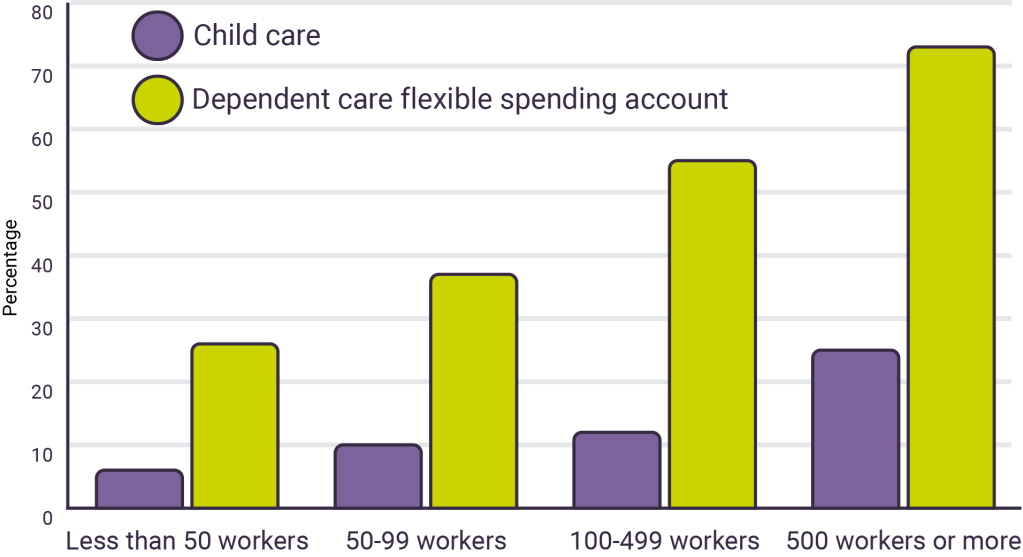
Supports that directly help offset costs of care were accessible to 13% of civilian workers overall in 2024, though the benefit varied by firm size. For instance, 25% of workers at the largest firms (with 500 or more workers) had access to full or partial reimbursement for the cost of care in 2024. This was just 12% for workers at firms between 100 and 499 employees and 10% or less for firms with fewer than 100 employees.
The most common supports for helping to offset child care costs include indirect methods, such as Dependent Care Flexible Spending Accounts (DCFSA). These offer employers and employees tax deductions for up to $5,000 of qualified child care expenses.
Civilian Worker Access to Select Employer Child Care Benefits by Firm Size in 2024
An estimated 73% of workers at large firms had access to DCFSA in 2024. The percentage of workers with access is lower as firm size decreases. For instance, just over half of workers at firms with 100 to 499 workers had access, while approximately one quarter of workers at firms with fewer than 50 workers had access. Despite their prevalence relative to other types of employer-sponsored child care supports, participation in DCFSA tends to be on the lower end among low- and moderate-income workers. Some reasons include a higher propensity for part-time work and occupations with higher turnover, both of which make participation more challenging.
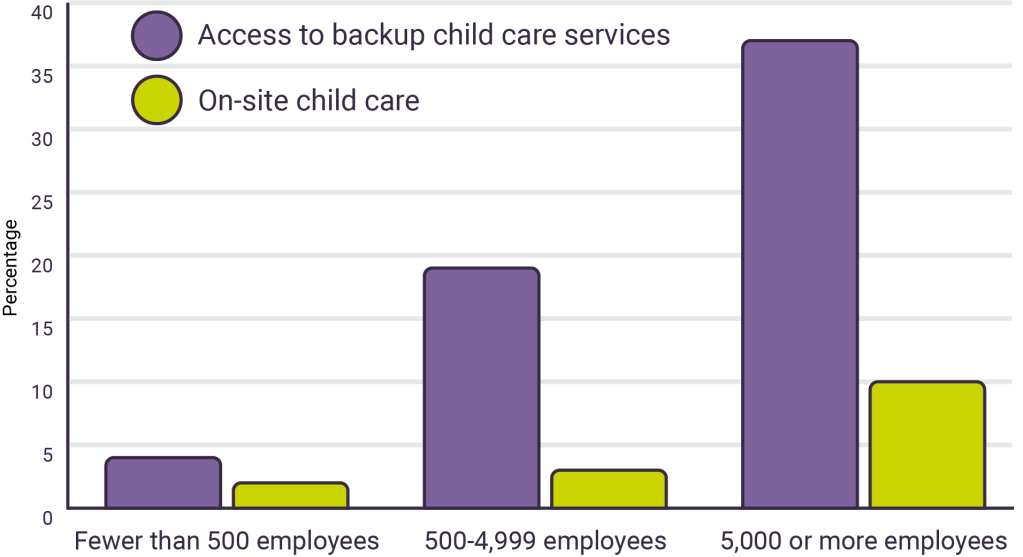
Child care supports such as on-site and backup care that require larger investments were the least common across employers but especially smaller firms. According to a health and benefits survey, roughly 4% of firms with fewer than 500 employees offered or planned to offer backup care in 2024 versus an estimated 19% of firms with 500 to 4,999 employees and 37% of firms with 5,000 or more employees. On-site child care is rarely offered regardless of firm size. While approximately 10% of firms with 5,000 or more employees offered or planned to offer on-site child care in 2024, an estimated 2% of firms with fewer than 500 employees offered or planned to offer on-site care.
In contrast, flexible work schedules that can help workers manage care needs, and possibly use less care, varies little by firm size, per some estimates. It is also a less commonly offered support. About 15% of civilian workers in 2024 were able to set their own schedules, according to firms participating in the National Compensation Survey. Other forms of flexibility, like telework, are more broadly available, with an estimated 41% of workers in 2024 able to telecommute or work from home at least part of the time, according to our calculations from the Federal Reserve’s Survey of Household Economics and Decisionmaking.
Finally, public-private partnerships may be the least common child care innovation but are gaining attention. It is unknown whether collaborating employers in public-private partnerships vary by firm size. These partnerships often involve collaboration among states, employers, nonprofits, and parents. The concept includes opportunities to split care costs to help with access. It can also mean investing in the supply of child care or meeting other needs that providers and private-pay parents often face alone. Partnerships may be an effective way to pool resources to pursue options that may otherwise be out of reach.
Percentage of Surveyed Employers Offering or Planning to Offer Benefits in 2024
Source: Mercer. (2023). Health and benefit strategies for 2023.
Approaches to supporting working parents
While many employer-sponsored child care supports are uncommon, particularly among smaller firms, there is increasing momentum around employer involvement to support parents with child care needs. Much of the motivation likely stems from the business case for supporting parent workers. Momentum is unlikely to occur evenly across employers given how they vary in ownership, industry, geography, wage levels, and firm size. Firm size is particularly salient to whether or not employers offer child care supports.
Given the variation among employers and constraints among small businesses in particular, what can small businesses do? There is no definitive or single answer. The strategies below highlight examples of how some small businesses across the country have chosen to support parent employees.
Strategies for small businesses
Multiple Federal Reserve Banks conducted outreach across the country to identify examples of strategies that small businesses have used. Four key strategies for supporting the child care needs of small businesses emerged. The supports themselves are not unique to small businesses. However, the way the small businesses—and in some cases, practitioners—approached these supports demonstrates why they were a fit for small business employers and their employees. The strategies include:
Information and Referrals
Minimizing administration time and investments on the part of employers by making informational resources available to both employees and employers.
Flexibility
Enabling parents to meet their care needs by thinking broadly about flexibility to include not just work schedules but options that might better facilitate work.
Financial Stipends and Subsidies
Increasing accessibility of child care by offering stipends and subsidies paid directly to providers for the use of licensed child care.
On- or Near-Site Child Care
Making licensed child care more available through the leveraging of partnerships to combine resources among multiple small businesses.
Information and referrals
Navigating child care solutions can be complex. Different informational resources and referrals exist that are intended to help parents navigate the child care decision-making process. Some solutions offer details on child care options with available spots in selected areas. There are informational resources that are private fee-based as well as publicly curated options that are free. The modest investment to leverage informational resources and referrals can make this approach a potential good fit for small businesses that are financially constrained.
In 2015, Dr. Bronner’s, an organic soap and personal care product company with fewer than 350 employees, implemented a mix of child care supports after learning from an employee survey that access to child care was a top concern. Dr. Bronner supplemented its child care benefits (see section on Financial Stipends and Subsidies) with a third-party child care management digital platform.3
San Diego, where Dr. Bronner’s is headquartered, has substantial care options. But knowing whether providers have availability and fit with a family’s needs and resources requires navigation. The amount of time it took for an HR staff person to try and offer this support to employees made it clear that outsourcing may be more effective and efficient. The digital platform Dr. Bronner uses contains information on providers. Dr. Bronner’s pays a fee per enrolled employee with the ability to enroll up to 50 employees in the program. Participating employees can search the platform to try and find options that fit their needs.
Other informational resource options for businesses may exist at state or local levels. There are also free information resources that small businesses may leverage within their localities.
Following the COVID-19 pandemic, the Iowa Department of Health and Human Services sought new ways to support the needs of families, child care providers, business and community leaders, policymakers and state agencies. Using pandemic relief funds, the department partnered with a university and subcontractor to build and maintain a free online informational tool available to the public. Iowa Childcare Connect (C3) includes a search function through its Child Care Search that provides Iowa’s families with real-time information on child care availability among local providers. C3 also includes data dashboards with statewide and community-level data on vacancies and the supply of child care by program type and child age. The dashboards also include estimates of the demand for child care across the state. While the potential benefits of C3 may be more straightforward for families and child care providers, the search functionality can also be a resource for employers to share with current and future employees who need child care for work. Similarly, the dashboards could be used to help business and community leaders better understand where child care gaps exist and inform strategies for addressing them.
In San Diego County, California, the YMCA offers free enhanced referrals with child care consultants to assist employees in finding child care solutions. Since 1980, the YMCA has operated as a child care resource and referral agency. Offering this service directly to businesses for their employees has been a more recent effort. It is a no-cost solution for small businesses to connect their employees to a child care resource. Participating employers are provided with a child care needs survey to assess the child care needs of staff. Then employees receive personalized, one-on-one support from a dedicated child care navigator.
Flexibility
Flexibility in how, when, or where to work can be a low- to no-cost benefit highly valued by employees. It can have positive effects on workers’ needs and ability to access care. Supporting or shifting to a family-supportive workplace may require a culture change more than it requires money. Flexibility can vary. It can include the ability to complete one’s work during unconventional hours or days, telecommuting, or even bringing one’s child to work. In different ways, these options may help mitigate access challenges.
Weiler, a manufacturer of paving equipment in Knoxville, Iowa, was searching for a new benefit to offer production employees. When surveying employees, child care did not surface as the major challenge. Since there is so little child care in the area, the norm is for employees to make it work with spouses and family. In response to high gas prices, Weiler decided to offer shifts that would reduce the number of days employees needed to commute. They offered production employees the option to work four 10-hour days, Monday through Thursday or three 12-hour days, Friday through Sunday. Weiler expected to need to offer incentives to get employees to take the weekend shifts but as shared by Megan Weiler Green, Weiler’s chief financial officer and general counsel, “The shifts were in high demand among existing employees and new employees were also applying for these jobs. Some are farmers, farming four days a week and working for us three days a week and utilizing our health care and benefits.” The shift options were not intended as a child care benefit. But Weiler has found several employees using them as a child care strategy, whether to offset when they need care during most of the week or to tag-team with a spouse working an opposite shift. Weiler had less than 500 employees when it started offering flexible shift options and has since grown to over 700 employees.
In 2006, W.S. Badger, an organic body product manufacturer in Gilsum, New Hampshire, agreed to let a new mom bring her baby to work. Badger would later build a program around this concept that continues today. Parents can bring their infants to work until they are six months old or crawling. Employees also receive three months of parental leave. This strategy has enabled parents and their infants to have more bonding time during the workday. It has also fostered a broader culture of support with workers getting to be occasional “baby holders” for their co-workers and leading to parents sharing tips. Cost wise, Badger does not expect new parents with babies at work to be working full-time. It is considered a light-duty accommodation for these workers. After six months, the babies typically transition to child care. Badger cannot fully attribute its better than average retention and women-led management team to the “Babies at Work” program. But they have seen nearly every new mother participate.
From a manufacturing company perspective, we are limited in ways that we can be flexible. Some employees would not have considered us without the new shift options. Employees appreciate the schedule for many reasons, including child care flexibility. Some employees are rejoining the workforce or supplementing self-employment because it can work.
— Megan Weiler Green, chief financial officer and general counsel at Weiler
We have people who wanted to return to work post-COVID but they just didn’t have child care slots. We wish we had a way to help them with that other than funding child care. What we can do is accommodate new parents by letting them bring their babies to work. We know they’re not working full-time but they are working with an accommodation, much like we’d accommodate someone with light duty after an injury – that’s the law. We’ve had nearly every new mom participate and now have so many women in positions of leadership.
— Emily Hall Warren, Director of People & Culture, Badger
Financial stipends and subsidies
Offering financial assistance to employees with child care needs may help reduce stress and increase employee commitment. This support generally gives employees choices about their options for care. Some employers put stipulations on the assistance. For instance, they require that care be licensed or accredited. Often, they require employees to share receipts with their employer for the care. This type of employer support does not necessarily make child care more available, but it may make available child care more accessible.
In addition to an online informational resource, in 2015, Dr. Bronner’s began offering employees a stipend to cover some of their care costs. The amount of the stipend has increased over time. Since the pandemic, it has amounted to $7,500 per employee annually. Dr. Bronner’s implements the stipend through its third-party child care management digital platform, which also performs benefit administration tasks. Through the platform, Dr. Bronner can vet providers ranging from the next-door neighbor to a large center. It also verifies their rates and conducts background checks. As long as the provider is or becomes enrolled in the platform, employees can apply the stipend. Employees are charged 50% of the costs of whichever provider they use and Dr. Bronner’s covers the other 50%, until the $7,500 is expended. Providers are also paid through the digital platform. This eliminates the need for reimbursement management and aims to improve the cash flow of employees who do not have to wait for the stipend to be applied. There is less management on Dr. Bronner’s side since the third-party child care management provider works individually with the child care providers.
Seamen’s Bank, a Massachusetts-based small business that employs approximately 70 workers, subsidizes their employees’ child care costs. This benefit was due to a child care center’s plans to expand. Cape Cod Children’s Place considered expansion and conducted focus groups to determine if there was a need. The center’s leadership presented the findings to community members, including Seamen’s Bank, which was interested in supporting its own employees. Seamen’s agreed to fund the center even if the slots were not used. But this was not needed since the new center had a waiting list upon opening. To help get the new center off the ground, Seamen’s committed to pay 65% of the care costs of its own employees who used the facility. Employees covered the remaining 35% through weekly payroll deductions regardless of their income. Employees do not receive bills from providers. Seamen’s handles all payments directly to providers. While Cape Cod Children’s Place was the first center that helped put this benefit in place, Seamen’s also works with other licensed providers if an employee requests it.
Farmers Bank & Trust (FB&T) in Blytheville, Arkansas, in the heart of the Mississippi Delta, observed that the high cost of child care was challenging young workers. This made it difficult to retain top talent and resulted in high turnover rates. To address this, FB&T began offering a tuition benefit that covers 50% of tuition costs, up to $5,000 annually, for state-licensed child care facilities. FB&T pays the providers directly at the beginning of the month. Of their 50 employees, eight use this benefit. FB&T also joined a business coalition – Excel by Eight – to learn about more ways to address their employees’ child care challenges. Excel by Eight’s Business Coalition is a group of Arkansas businesses and employers that prioritize child care.
Our operation runs 24/7 – three shifts. This has helped us with some of our parents working outside the traditional 9-5. So that independent provider has come into play several times now for workers working second shift when centers are not open and the worker may be a single parent. This is one of the ways we’ve helped with retention especially for shifts outside usual business hours.
— Lilia Vergara, human resources, Dr. Bronner’s
Listening to employees and addressing their needs is not just good for morale — it is good for business. By making child care more accessible and affordable for working parents, businesses can support their employees and strengthen their communities.
— Randy Scott, president and CEO of Farmers Bank & Trust
On- or near-site child care
The fourth strategy—establishing on- or near-site child care by collaborating with other small businesses—may be a way to help smaller employers offer more child care benefits to their workers. While not a low-cost strategy, these partnerships can allow small businesses to pool resources for greater impact. Also, with a larger pool of workers, these firms can be better positioned to estimate uptake for, and justify the costs of, child care supports requiring more sizable investments.
Confronted with a persistent labor crunch in rural Maine, Maine Woods Company (MWC) and two partners have invested in a child care facility. MWC, Seven Islands Land Company, and Portage Wood Products are under shared ownership. A survey revealed that the county lacks 500 child care spots. MWC asked its sister companies to contribute seed funding. One of the companies had no employees with children but given this may change, the company agreed. The partners used seed funding to purchase land to be donated to a 501(c)(3), independent nonprofit child care center. After the center opens, the partners may choose to pay for spots for employees or to reserve spots for their workers as needed. But they will not need to own and operate the center directly. The nonprofit status has made the effort eligible for state and federal funds, which the lead small business, MWC, is actively pursuing. The effort has not been without roadblocks. There has also been a learning curve related to zoning approvals and federal funding. But the partners are committed to making the center a reality.
The Ashland Community Foundation’s Women’s Fund Steering Committee spearheaded a public-private partnership to address local child care needs in Ashland, Ohio. This work started by surveying the local workforce about child care needs. The results revealed that child care, especially infant care, is a challenge for working parents across all income groups. This finding led the committee members to reach out to local businesses to explain how a lack of local child care options played a role in staff hiring and retention challenges. This outreach led to discussions about opening a child care facility run by a new nonprofit entity. Almost $4.8 million was raised via eight grants, 127 individual donors, and donations by 45 employers and 13 faith-based organizations. Approximately $3.8 million was dedicated to building the facility, leaving a roughly $1 million endowment to help keep tuition affordable while providing above-market wages to the child care workers. Tuition supports are income-based and/or employer subsidized. Employers making annual donations are allocated a certain number of tuition-assisted spots for their respective employees. Currently, eight local employers participate and offer spots to their employees. The 150-space facility is located in a business park that houses 27 businesses with over 1,200 full-time employees and is also open to the general public. The center opened in the summer of 2024.
HR folks kept coming to me saying, ‘I could get this lady or gentlemen [to work here] if we had a place for their kids.’ There was no place to put their children…no licensed daycare within 30 miles. There used to be a small one that closed. I went to ownership and said, ‘I don’t really want to do this, but we have to find a way to create some child care.
— Scott Ferland, general manager, Maine Woods Company
The power of creative strategies
These four strategies demonstrate how some small businesses and practitioners sought to support the child care needs of working parents. Supports can be potentially impactful even if they require minimal time and resources. For more complex supports requiring greater investments of time and resources, creative approaches through partnership- and nonprofit-models or otherwise may be pathways to consider.
These examples from across the country illustrate how several small businesses have worked to overcome common constraints that smaller firms face. By implementing low-cost or creative child care supports small businesses may be better positioned to attract, retain, and support their workers, with the potential to have a positive impact on the broader economy.
While the availability of jobs is a top positive factor affecting conditions for finding work into the next year, the affordability of child care continues to be a significant negative factor.
— Kyle Fee, Cleveland Fed
Acknowledgements
We gratefully acknowledge those who contributed information and gave their time to this piece, including representatives from the organizations mentioned in this article along with members of the Federal Reserve’s Early Care and Education Work Group.
Contributing work group members
Erika Bell, Federal Reserve Bank of St. Richmond
Jessica Coria, Federal Reserve Bank of San Francisco
Theresa Dunne, Federal Reserve Bank of Philadelphia
Kyle Fee, Federal Reserve Bank of Cleveland
Alma Felix, Federal Reserve Bank of Philadelphia
Amy Higgins, Federal Reserve Bank of Dallas
Ana H. Kent, f., Federal Reserve Bank of St. Louis
Suchitra Saxena, Federal Reserve Bank of Chicago
Nicole Summers-Gabr, Federal Reserve Bank of St. Louis
Xiaohan Zhang, Federal Reserve Bank of Dallas
Report assistance
Jennie Blizzard, Fed Communities
Crystal Flynn, Fed Communities
Natalie Karrs, Federal Reserve Bank of Cleveland
Anne O’Shaughnessy, Fed Communities
Notes: Any mention of specific tools or services by name are not endorsements by the authors, the Federal Reserve Banks, the Federal Reserve System, or the Federal Reserve Board of Governors.
[1] Based on authors’ calculations of the Current Population Survey Annual Social and Economic Supplement.
[2] Based on authors’ calculations of the Current Population Survey Annual Social and Economic Supplement.
[3] Dr. Bronner uses a platform called Tootris. Another example of a third-party child care management digital platform is Upwards.
Brittany Birken serves as a director and principal adviser for Community and Economic Development and co-leads the Atlanta Fed’s Center for Workforce and Economic Opportunity.