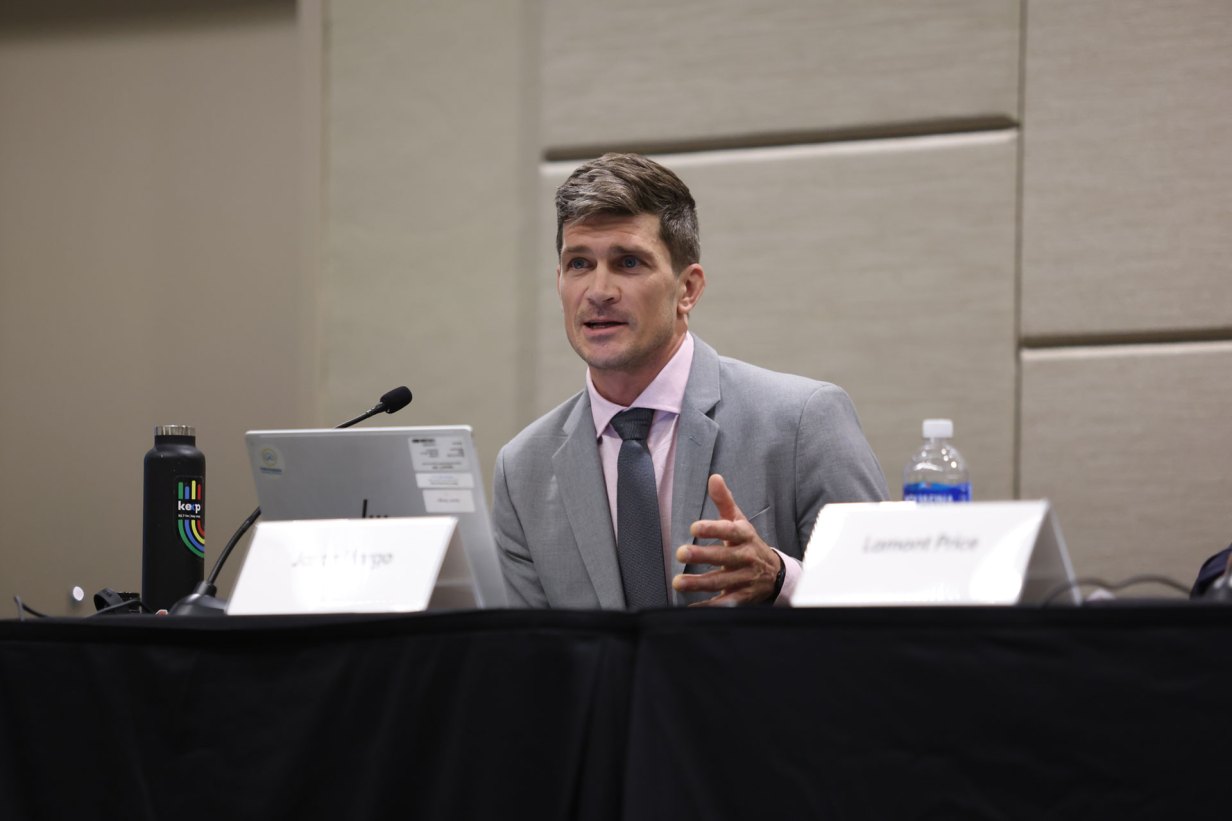
Jason Vargo, senior community development researcher at the Federal Reserve Bank of San Francisco, moderated a session entitled “Leveraging Opportunity Zones to Advance Community Development” at the 2026 National Community Investment Conference in Phoenix, AZ.

The revamp of a nearly nine-year-old tax incentive to help distressed communities, just as hundreds gathered for a national community investment conference, presented a unique prospect for the community development field. And the San Francisco Fed seized the opportunity.
“I was introduced to opportunity zones (OZs) leading up to our National Community Investment Conference held in March,” said Jason Vargo, a senior researcher in Community Engagement and Analysis at the San Francisco Fed. “There was a lot of interest and curiosity around opportunity zones given the potential for a lot of investment in communities around the country.”
OZs were created in 2017 as a tax incentive and economic development tool. The goal was to boost long-term private investment in low-income census tracts to encourage economic growth. OZs can create jobs while providing tax incentives for investors. Between 2018 and 2024, investors committed more than $100 billion to OZs, primarily in real estate nationally.
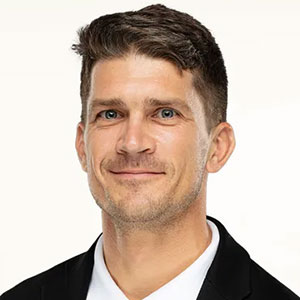
“In my career and during schooling, I’ve often investigated questions at the intersection of communities, neighborhoods, places, and human well-being,” he said. “I’m always interested in how [a] place is impacting people’s quality of life.”

Jason Vargo
Federal Reserve Bank of San Francisco
OZ 2.0
Revised in 2025, the tax benefit became permanent as OZ 2.0. Revisions included narrowing the definition of low-income areas and offering stronger incentives to invest in rural communities. New reporting requirements aim to enable clearer community-level input involving investment activity and outcomes.
OZ 2.0 timelines and eligibility rules for communities and investors followed in 2026. In July, state governors were told that they had until mid-October to nominate for inclusion up to 25% of their low-income census tracts. The Treasury Department plans to issue the final list of OZ 2.0 tracts by December.
Vargo said the community investment conference presented a timely venue to highlight the rollout and potential of OZ 2.0. Leading up to the conference, the San Francisco Fed strategized about how to discuss OZ 2.0 with conference attendees and to gauge the field’s interest and knowledge gaps, he said.
“It’s not just designed for any one type of place or community. It’s also not limited to a certain sector or a certain type of project,” he said. “It’s broad and casts a wide net and can benefit urban and rural communities in every state. We wanted to make sure at the conference that we were representing a lot of different perspectives and knowledge points about OZs.”

Place-based influences
OZs are also a place-based initiative. As such, they involve multiple stakeholders in the same place collaborating to create sustainable progress.
In fact, Vargo’s interest in OZs stemmed from his career in place-based work. Before joining the San Francisco Fed, he led COVID-19 modeling and development of the Health Equity Metric—a means of connecting economic activity and pandemic recovery in disadvantaged communities—for the California Department of Public Health. The work informed policies that were tied to place-based disease reduction in neighborhoods across the state.
“In my career and during schooling, I’ve often investigated questions at the intersection of communities, neighborhoods, places, and human well-being,” he said. “I’m always interested in how [a] place is impacting people’s quality of life.”
A Detroit native, Vargo also said his experience living in five US cities and Vietnam helps him understand the disparities that individuals face. “I started thinking more about the physical, social, and economic differences between places, which decisions shape a place [who makes them], and how they affect the quality of life for the people living there.”
OZ work and community-level data
Following the conference, the San Francisco Fed continues to convene relevant parties and distribute information and resources about opportunity zones.
“We’re trying to spotlight places that have done well and help them tell their stories,” Vargo said. “I think that’s going to be a big part of ensuring that there are impactful projects in OZ 2.0.”
The San Francisco Fed’s Community Engagement and Analysis group is helping banks consider how OZs can advance their Community Reinvestment Act work, he said.
Aside from OZs, Vargo said he’s excited about projects that employ analytics to tell stories geared to a local audience. As outreach specialists on his team discuss projects with local officials, Vargo tries to supply evidence to help answer questions or to help bring stakeholders together to discuss problems.
For example, Vargo used data from the St. Louis Fed’s Bank On National Data Hub and the New York Fed’s Credit Insecurity Index during a banking and financial empowerment meeting in California’s agricultural center, the Central Valley. The data reveal that residents in the valley’s Kings County lagged in access to credit and its use. The finding helped meeting participants steer the county to become a candidate for the Bank On initiative. The effort works to connect consumers with safe, affordable bank accounts. Vargo describes the project as an example of “applied evidence-based interaction with communities.”
Continuous learning
Vargo said he’s optimistic about the potential advances OZs can achieve in economically distressed communities. And he adds that he’s grateful to continue learning more about the incentive and share what he’s discovered.
“I like spending my time doing things that people find useful,” Vargo said. “People are interested in opportunity zones and want more information. So, if I can help surface that or bring people together and tell the stories of people who are strengthening communities using opportunity zones, then I’m going to try to do that.”
Thanks to Darryle Aldridge at the Federal Reserve Bank of Richmond for contributions to this article.