









2026 Worker Perspectives
When every dollar counts: Inside the economic struggles of workers who earn low to moderate incomes
About the research
For many lower- and moderate-income workers and job seekers, survival is replacing economic mobility. This report explores how these individuals navigate tight budgets and a challenging job market. To overcome these obstacles, they are adapting finances and career plans, while also speaking hopefully about their personal ability to manage uncertainty.

“I don’t think anybody [in this focus group] makes enough to be comfortable. We make enough just to live.” — Participant with household income less than $50k annually
“So thankfully I’m comfortable, but let’s just say on thin ice, there’s definitely like one or two paychecks away from not being, you know, in the right place…” — Participant with household income between $60k–$75k annually
“The American dream is just that, a dream. It’s not even reachable anymore to have the house and the white picket fence.” — Participant with household income less than $50k annually
Worker Perspectives
2026 Report
The Worker Perspectives Report explores how workers are navigating rising costs, limited opportunities, and a challenging job market. To navigate these obstacles they are adapting finances and career plans, while also speaking hopefully about their personal ability to manage uncertainty. In their employment, they prioritize flexibility, work-life balance, and fair pay. Here’s what workers are saying.

Related content

Fostering maximum employment: Why the Federal Reserve studies investments in America’s workforce
The Federal Reserve’s dual mandate includes promoting maximum employment. This article features examples of the various ways Fed research, outreach, and partnerships contribute to achieving this optimal state of the labor market.
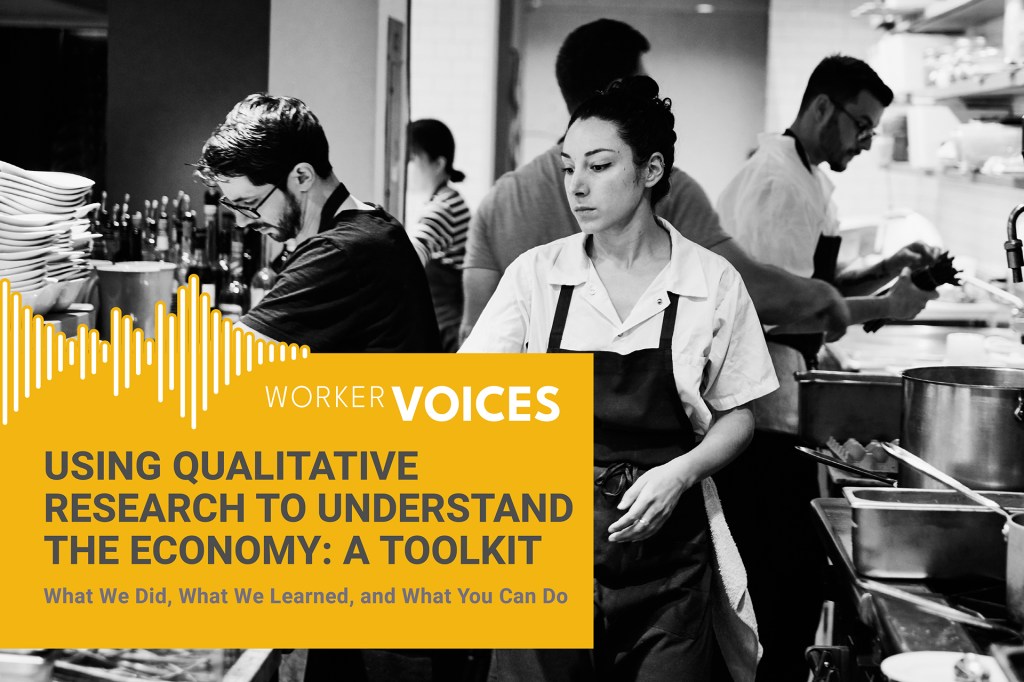
Using Qualitative Research to Understand the Economy: A Toolkit
The toolkit offers insights on using community-engaged qualitative research practices gleaned from the Federal Reserve’s Worker Voices Project and shows how others can use these methods in their own work. This toolkit is for researchers, policymakers, employers, and workforce organizations interested in partnering with the populations they serve and elevating community perspectives.
Worker Voices Special Brief: Self-Employment, Dreams Versus Reality
Worker Voices participants described weighing the tradeoffs of self-employment from the independence it gave to its income generation potential. This research found that participants were pushed or pulled into self-employment for a variety of factors and their experiences did not align with their expectations of this work.

Worker Voices Special Brief: Pursuing Advancement through Personal Investment
Worker Voices participants described their persistence in taking steps to improve their employment outcomes. They pursued skill-building opportunities and were more willing to leave lower-quality jobs, sometimes to pursue self-employment instead. However, their efforts were met with mixed results.
Worker Voices Special Brief: Barriers to Employment
Worker Voices participants described the challenges facing individuals without a four-year degree as they navigated the job market during a global pandemic. Common barriers to work included an evolving labor market, individual attributes, work-family conflicts, and concerns regarding individual well-being.
Worker Voices Special Brief: Perspectives on Job Quality
For Worker Voices participants, a quality job checks five boxes. Workers with a quality job are adequately compensated, treated well, secure in their position, given flexibility around hours and location, and engaged with the work.
Worker Voices: Shifting Perspectives and Expectations on Employment
Worker Voices provides a unique view into how job seekers and workers in lower-wage roles navigated the labor market at the onset of the COVID-19 pandemic and through recovery—and how it changed what they expect from a job.

Acknowledgements
We are grateful for everyone who contributed to Worker Perspectives.
Thank you to the individuals who shared their insights and perspectives. This research reflects their lived experiences.
Finally, we recognize the Worker Perspectives team for their contributions.
Have questions about Worker Perspectives? Contact us
Research, data, and methodology inquiries
Sarah Miller, Atlanta Fed
Merissa Piazza, Cleveland Fed
Elizabeth Bogue Simpson, Atlanta Fed
Kristen Broady, Chicago Fed